

Why Your Vortex Flowmeter Fails to Read Low Flow (And How to Fix Sizing Errors)

A DN80 vortex flowmeter on a compressed air branch line reads accurately during peak daytime shifts, yet drops to zero—or flickers erratically between 0 and 2m³/h—during low-load night operations. Swapping out the transmitter rarely solves this issue because the root cause is almost always hydraulic sizing, not hardware failure.
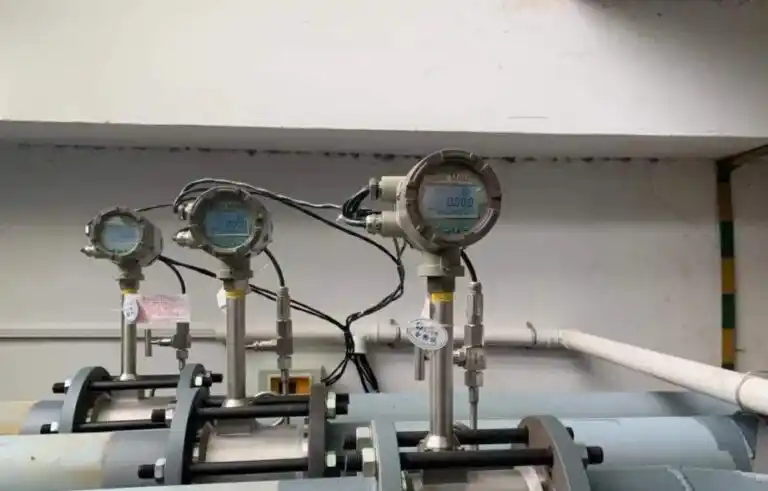
Why Does a Vortex Flowmeter Drop to Zero at Low Flow?
A vortex flowmeter fails to read low flow when fluid velocity drops below the minimum threshold required to generate stable Kármán vortices—typically a Reynolds number (Re) below 20,000. At low velocities, weak vortex pulses are drowned out by pipe vibration or automatically suppressed by the meter’s low-flow cutoff setting, forcing the output to zero.
The Physics Behind Signal Dropouts
Vortex meters measure flow by counting vortices shed off an internal bluff body (shedder bar). The shedding frequency is directly proportional to fluid velocity ( f = St · v / d ), where St is the Strouhal number and d is the bluff body width.
When flow drops, the kinetic energy of the fluid decreases exponentially. For low-density gases like compressed air or saturated steam, the minimum detectable velocity is significantly higher than for liquids. According to industry measurement standards , once the Reynolds number falls out of the linear shedding zone, the Strouhal number shifts and the piezoelectric sensor can no longer distinguish true flow pulses from background mechanical noise.
4-Step Diagnostic Checklist: Is It Sizing, Settings, or Vibration?
Before unbolting the meter from your pipeline, run through these four checks to confirm whether you are facing a sizing mismatch or a simple configuration error:
- Check the Low-Flow Cutoff (LFC) Setting: Manufacturers program an LFC threshold to prevent the meter from counting zero-flow pipe vibration. If your night shift flow sits just below the LFC percentage, the DCS will display a flat zero. Lowering the LFC slightly can recover marginal readings—provided the pipe is vibration-free.
- Verify Operating Velocity Against Pipe Diameter: Calculate the actual velocity (v ) at your minimum flow rate. If your compressed air velocity drops below 5–7 m/s (or below 0.5 m/s for liquids) in a DN80 line, the pipe is oversized for the meter.
- Isolate Mechanical Pipe Vibration: Close the downstream isolation valve while keeping the line pressurized. If the meter still flickers between 1–2 m³/h at zero flow, compressor or pump vibration is masking your low-flow signal.
- Inspect Grounding and Shielding: Poor electrical grounding introduces 50/60 Hz AC hum into the sensor amplifier, which mimics or buries weak low-frequency vortex pulses.
The Hidden Sizing Trap in Gas & Steam: Operating vs. Standard Flow
In over a decade of manufacturing and field-testing industrial flow meters in Kaifeng, China, KFBEST engineers have found that 70% of gas vortex sizing errors stem from one mistake: sizing the pipe using Standard Flow ($\text{Nm}^3/\text{h}$) instead of Operating Flow (m³/h).
When compressed air is pressurized to 7 bar (0.7 MPa), its actual volume shrinks to roughly one-eighth of its standard volume. If an engineer selects a DN80 meter based on the standard flow figure, the actual operating velocity inside the pipe will be 8 times slower than expected—pushing nighttime flows straight into the meter’s dead zone.
To prevent this, always convert standard gas flow to actual operating conditions before checking the manufacturer’s turndown ratio (typically 10:1 to 15:1). For lines with fluctuating pressure or temperature, upgrading to a temperature and pressure compensated vortex flow meter ensures real-time density correction and accurate mass or standard volume output.
Need a quick sizing verification? Send your minimum/maximum flow rates, operating pressure, and pipe size to the KFBEST engineering team for a free hydraulic velocity check—we support custom calibration and OEM/ODM specifications for global B2B projects.
4 Proven Fixes for Low-Flow Blind Spots
Replacing a faulty-looking meter with an identical size will only repeat the problem. Use the matrix below to choose the most cost-effective remediation for your plant:
| Remediation Strategy | Best For | Pros | Limitations |
| 1. Concentric Reducers (Downsizing) | Existing oversized pipes (e.g., DN80 pipe reduced to DN50 meter) | Increases fluid velocity by 2x–3x; lowest retrofit cost | Slightly increases permanent pressure drop; requires straight-run lengths |
| 2. Remote-Type Anti-Vibration Meter | High-vibration compressor branches or hot steam lines | Separates electronics from heat/vibration; cleaner DSP signal at low flow | Does not fix severe hydraulic oversizing (Re < 10,000) |
| 3. Dual-Meter / Bypass Setup | Extreme daytime-to-nighttime turndown ratios (> 20:1) | Captures both peak loads and tiny night leaks accurately | Higher piping complexity and valve automation cost |
| 4. Switch Measurement Technology | Ultra-low gas flows or variable low-density media | Thermal mass, turbine, or Coriolis meters offer 30:1 to 100:1 turndown | Higher upfront capex (especially for Coriolis) |
When to Choose Each Vortex Configuration
- Clean, steady-flow pipelines: A standard vortex flow meter paired with concentric reducers is the most economical fix when your only issue is low velocity.
- High-vibration or cramped spaces: If compressor vibration forces you to keep the LFC high, switching to a remote-type vortex flow meter isolates the converter from mechanical shock, allowing lower signal thresholds.
- Wide-range non-vortex applications: When your minimum Reynolds number simply cannot support vortex shedding, switching technologies is the only reliable path. Because KFBEST manufactures a complete portfolio—including electromagnetic, turbine, ultrasonic, and Coriolis mass flow meters—our engineers can objectively match the right technology to your medium rather than forcing a vortex meter into an unsuitable line.
How to Size a Vortex Flowmeter Correctly from Day One
Follow this sequence during procurement to eliminate low-flow blind spots permanently:
- Start with Minimum Operating Flow: Never size a meter solely by existing pipe diameter or maximum compressor capacity. Anchor your selection to the lowest sustainable operating flow rate.
- Target the Sweet Spot: Aim for normal operating flow to sit at 50%–70% of the meter’s upper range limit, ensuring minimum flow stays comfortably above 10% of full scale.
- Verify Reynolds Number: Confirm that $Re \ge 20,000$ at minimum flow . If Re sits between 10,000 and 20,000, expect reduced accuracy; below 10,000, downsize the meter or switch technologies.
- Account for Straight Pipe Runs: If you downsize using concentric reducers, allow at least 15D–20D upstream and 5D downstream straight pipe lengths to stabilize the velocity profile before the bluff body.
Still struggling with zero-readings or erratic DCS totals? Whether you need a properly sized vortex meter with custom concentric reducers, an OEM/ODM instrumentation partner, or a multi-technology flow solution for complex industrial media, KFBEST provides direct factory technical support from our manufacturing base in Kaifeng, China. Reach out with your process datasheet to get an accurate sizing calculation today.
FAQs
A vortex flowmeter reads zero at low flow when fluid velocity drops too low to shed stable Kármán vortices (typically when the Reynolds number falls below 20,000). At this point, the weak pulse signal is either drowned out by pipe vibration or automatically blocked by the meter’s low-flow cutoff setting.
Yes. The most cost-effective fix is installing concentric reducers to step down the pipe diameter (for example, reducing a DN80 line to a DN50 meter). Downsizing increases the local fluid velocity through the meter body, pushing low-flow rates back into the measurable linear range while keeping straight-run requirements intact.
Most industrial vortex flowmeters require a minimum Reynolds number ($Re$) of 20,000 to maintain linear accuracy and a stable Strouhal number. Some meters can still detect pulses between $Re$ 10,000 and 20,000 with reduced accuracy, but below 10,000, vortex shedding stops completely and the meter will drop to zero.
If your application has a turndown ratio exceeding 15:1 or ultra-low gas velocities, consider switching to a thermal mass flow meter, gas turbine flow meter, or Coriolis mass flow meter. These technologies handle much lower velocities and wider turndown ratios without relying on vortex shedding thresholds.
admin
System Administrator
Thank you for reading our technical insights and industry news.