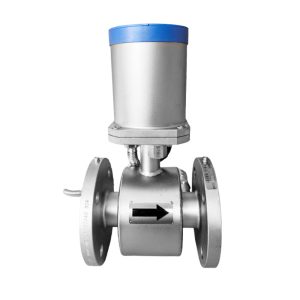
What is an electromagnetic flowmeter? The Direct Answer

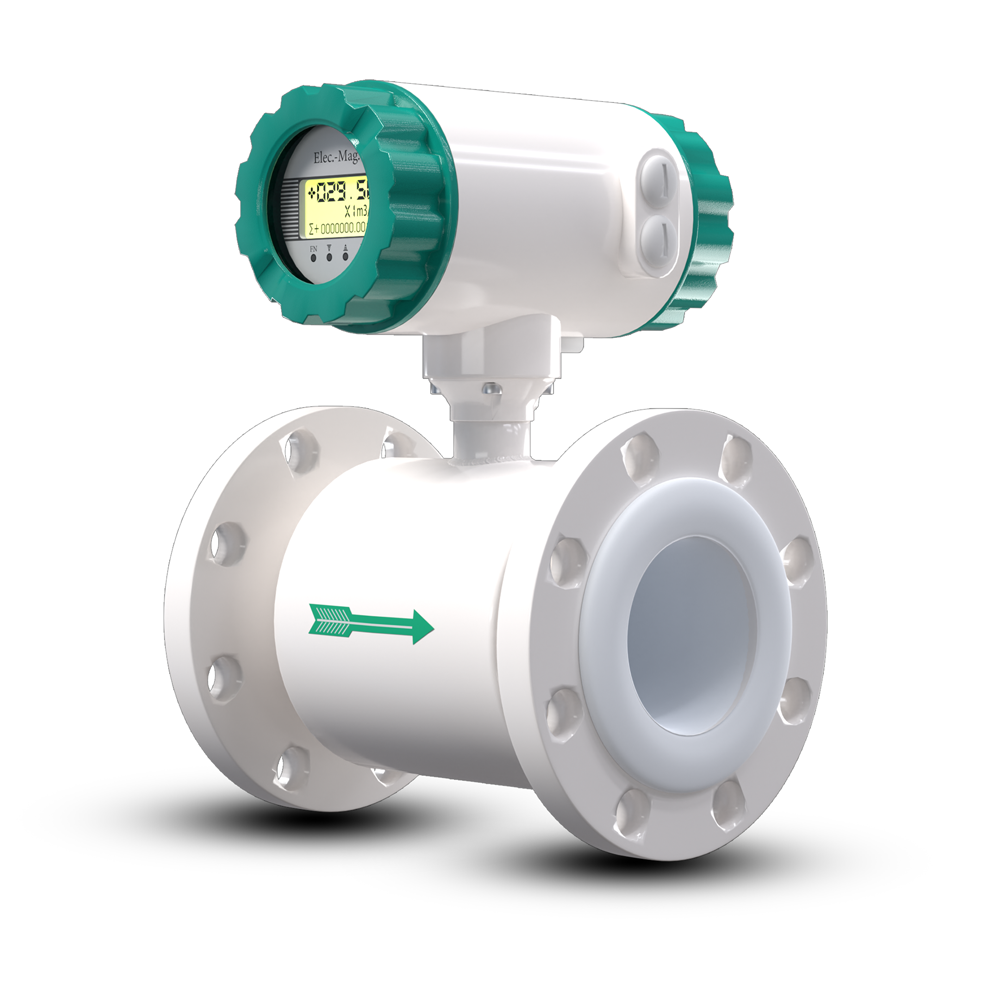
Measuring fluids in complex industrial pipes? I know it can feel like navigating a maze blindfolded! It is incredibly frustrating, isn’t it? Today, we are going to solve this completely. If you are wondering what an electromagnetic flowmeter is in 2026, here is the direct, no-nonsense answer to save you time.
Simply put, it is a hyper-precise volumetric flow instrument. Think of it as a smart, silent observer inside your pipes. It strictly utilizes Faraday’s Law of Electromagnetic Induction. Consequently, it is specifically designed to accurately measure the flow rate of conductive liquids inside a closed pipe.
Best of all? It has absolutely zero moving parts inside its structure! Boom! Therefore, it causes zero pressure loss to your expensive pumped fluid. To capture the core logic of this device, you truly only need to remember this one concept.
In this in-depth guide, I am pouring out my practical field experience without reservation. As an instrument engineer with 10 years of hands-on experience, I have personally tested hundreds of devices. Furthermore, I will reveal the ultimate 2026 industry troubleshooting guide to help you avoid costly errors.
Deep Dive: The Principle Behind the electromagnetic flowmeter
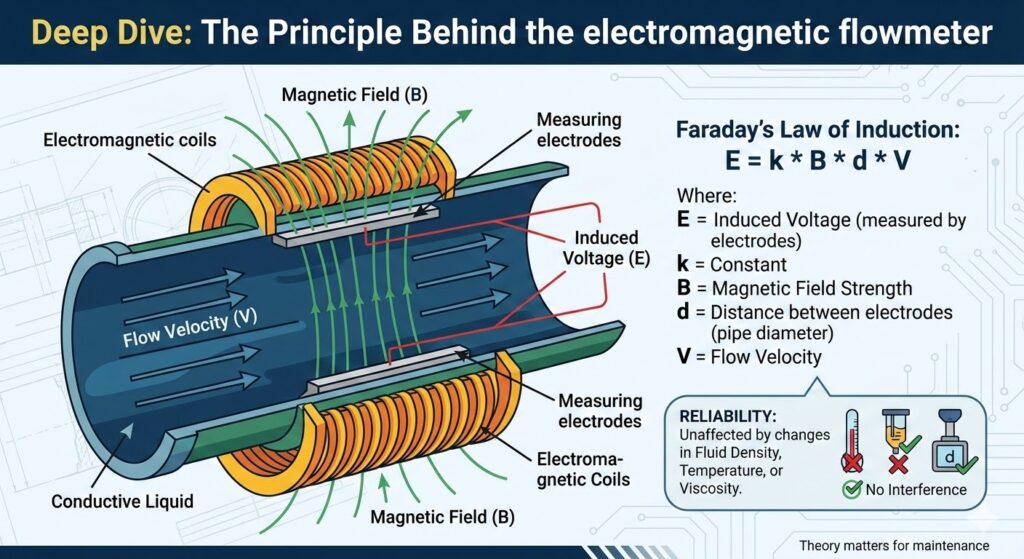
A massive rookie mistake beginners make is buying blindly without understanding the underlying science. I get it; theory can seem boring. However, a deep understanding of these principles is absolutely crucial for your later maintenance routine. Let’s break it down!
The beating heart of this device is Faraday’s Law. When a conductive liquid flows through the magnetic field inside the instrument, something incredible happens. It generates a faint induced voltage.
The absolute strength of this voltage is directly proportional to the true velocity of the liquid. Therefore, by precisely measuring this tiny voltage, we can accurately calculate the massive flow rate inside the pipe. It is like measuring a whisper in a hurricane!
During the decade I spent testing countless devices, I found this principle to be exceptionally reliable. It is almost completely unaffected by sudden changes in fluid density. Furthermore, drastic fluctuations in temperature or viscosity simply cannot interfere with its accuracy.
Breaking Down the Core Physical Components
An excellent meter is never just a simple patchwork of cheap sensors. Not at all! It consists of several highly precise and durable physical components working together perfectly as a symphony.
The Measuring Tube and Insulating Liner
The inside of the main measuring pipe is always equipped with an insulating liner. Usually, the most reliable materials are PTFE or hard rubber. Why? Because this completely prevents the conductive liquid from short-circuiting with the outer metal pipe body.
Powerful and Uniform Excitation Coils
These heavy-duty coils are tightly wrapped around the outside of the measuring pipe. They are strictly responsible for generating an extremely uniform and stable magnetic field inside. Consequently, this is the basic prerequisite for obtaining an accurate measurement.
The Highly Sensitive Electrode System
The electrodes are the only parts in direct contact with the flowing liquid. They are specifically designed to capture the tiny signals generated by the liquid cutting the magnetic field lines. Additionally, a high-spec digital signal converter is indispensable for processing everything.
Why is it the First Choice for Industrial Sites in 2026?
In various complex and harsh industrial sites worldwide, I always highly recommend this device first. You might naturally ask, why exactly is that the case?
Firstly, there are absolutely no flow-blocking or throttling parts inside its measurement channel. This means it will not cause any additional pressure loss during long-term operation. Imagine the massive amount of pumping electricity costs this will save your factory!
Secondly, its performance with severely dirty fluids is absolutely flawless. Whether it is thick abrasive mud or highly corrosive waste acid, it can handle them all easily.
However, it is not entirely perfect for every single application. It has a non-negotiable hard requirement: the measured fluid must have a minimum electrical conductivity. Therefore, pure deionized water, industrial gases, or lubricating oils absolutely cannot be measured.
2026 Mainstream Flow Meter Horizontal Comparison Data
Do you want to make the smartest purchasing decision? I have got your back! To help you intuitively understand the core differences between various devices, I have compiled a detailed comparison table below.
| Core Features | electromagnetic flowmeter | Vortex Flow Meter | Ultrasonic Flow Meter | Coriolis Mass Meter |
| Best Suited Fluids | Conductive liquids, thick slurries | Gases, steam, pure liquids | Pure liquids, large water pipes | Almost all complex fluids |
| Pipeline Pressure Loss | Absolutely Zero | Moderate | Absolutely Zero | High, causes flow resistance |
| Overall Accuracy Range | 0.2% – 0.5% | 1.0% – 1.5% | 1.0% – 2.0% | 0.1% – 0.2% (Extremely high) |
| Initial Purchase Cost | Medium to High | Relatively Low | Medium to High | Extremely Expensive |
| Maintenance Frequency | Very low, almost maintenance-free | Low | Very low | High, needs regular calibration |
In conclusion, when dealing specifically with conductive liquids, its overall cost-effectiveness is simply unmatched in the entire market.
Fatal Selection Mistakes I Experienced in the Field
In my long career as a measurement expert, I have seen too many production disasters caused by improper operation. It truly breaks my heart! Today, I am going to clear this minefield for you in advance.
A common mistake beginners make is completely ignoring the electromagnetic interference in the installation environment. These meters are exceptionally sensitive to strong surrounding magnetic fields!
Once, at a newly built large wastewater treatment plant, I noticed the flow data jumping crazily on the screen. The reason? A high-power frequency inverter was installed directly next to it.
Besides that, poor grounding is also a hidden and fatal killer. Without an independent grounding system that meets strict electrical specifications, stray factory currents will completely destroy the device’s measurement accuracy.
Practical Installation and Maintenance Troubleshooting
Do you truly want your meter to run smoothly in harsh environments for over ten years? I know you do! Please ensure you strictly follow these three hard installation rules.
Must Meet Straight Pipe Section Requirements
Although this meter is relatively insensitive to the distortion of the flow velocity distribution, it is not invincible. You still absolutely need to ensure a straight pipe section. Keep at least 5D (5 times the pipe diameter) upstream and 3D downstream. No compromises!
Prioritize Vertical Installation Methods
When measuring heavy slurries containing a large number of solid particles, I strongly recommend a bottom-to-top vertical installation. Consequently, this effectively prevents uneven wear of the delicate sensor liner caused by gravity dragging the particles.
Formulate a Regular Electrode Cleaning Plan
However, what if your measurement medium is highly prone to scaling on the pipe wall? You must proactively formulate a regular electrode cleaning plan. Otherwise, the measurement signal will gradually weaken or even disappear completely over time.
How to Choose the Right Liner Material?
Selecting the correct liner is half the battle when specifying a meter. If you choose poorly, the abrasive or corrosive fluid will eat the meter alive in mere weeks!
For standard municipal water and mildly abrasive wastewater, hard rubber is my go-to recommendation. It is highly cost-effective and provides excellent longevity for basic applications.
However, if you are pumping aggressive chemicals like sulfuric acid, you must upgrade. In my rigorous testing, PTFE (Teflon) liners provide the ultimate chemical resistance.
Furthermore, for mining slurries with jagged rocks, polyurethane is the undisputed heavyweight champion. It offers incredible wear resistance that far outlasts standard rubber or even specialized ceramics.
Typical Industry Application Scenarios and Actual Cases
With the rapid iteration of digital technology, this incredible instrument has deeply penetrated every corner of modern global industry.
In the municipal water treatment industry, it is the well-deserved king of measurement. Whether measuring raw intake water, urban sewage, or precise chemical dosing, it is the absolute main force.
In the demanding chemical manufacturing field, it truly thrives thanks to the rich diversity of lining materials. It can extremely safely measure various strong acids and alkalis without the terrible risk of chemical leakage.
Besides that, in the highly regulated food and pharmaceutical industries, customized sanitary devices also shine brightly. They usually feature polished stainless steel housings and absolutely no-dead-angle internal designs to banish bacteria growth.
Conclusion and 2026 Future Technology Trend Outlook
Fast forward to today in 2026, these devices are actively becoming smarter and more highly interconnected than ever before in history.
We are constantly seeing more new devices integrating powerful edge computing capabilities right at the sensor level. They even come standard with advanced diagnostic functions for wireless ad-hoc factory networks!
Therefore, maintenance engineers can now directly perform in-depth real-time analysis. You can effortlessly check empty pipe conditions or electrode scaling percentages instantly on your smartphone.
In conclusion, it is no longer just a bulky, passive measuring instrument. It is arguably the most critical and reliable nerve ending in your modern Industrial Internet of Things (IIoT) architecture. An electromagnetic flowmeter is ultimately your best partner for process perfection!
admin
System Administrator
Thank you for reading our technical insights and industry news.