The Insertion Revolution: Why Electromagnetic Flow Meters Are Redefining Large-Pipe Measurement

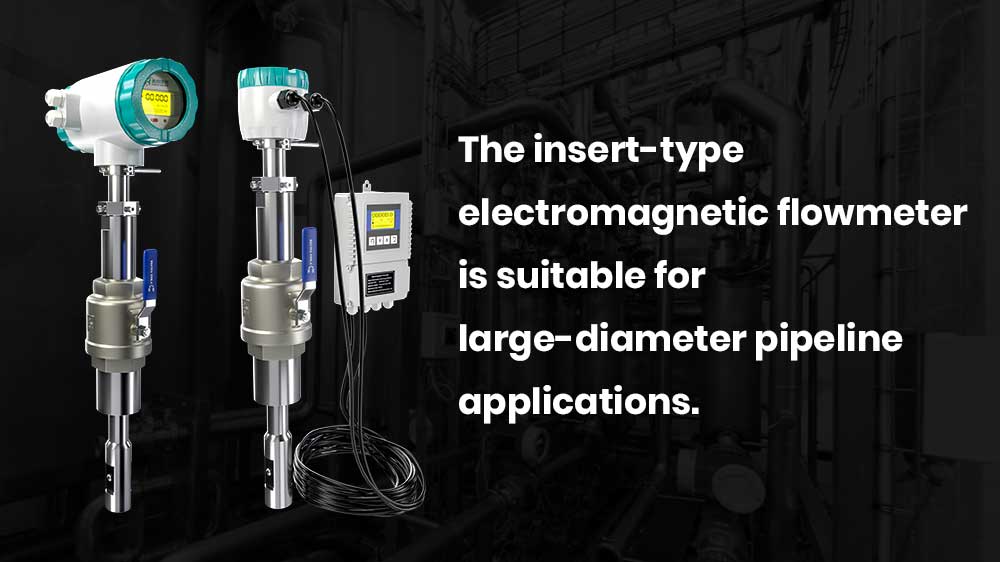
Executive Summary: The “1/10th Cost” Rule
In 2026, the shift from full-bore to insertion electromagnetic flow meters is driven by a simple industrial reality: Scalability without Shutdown. For pipes exceeding 300mm (12 inches), insertion magmeters provide up to 90% cost savings compared to full-bore units, while maintaining the same Faraday’s Law reliability and enabling “Hot-Tap” installation without process downtime.
1. Technical Foundation: How Insertion Magmeters Work
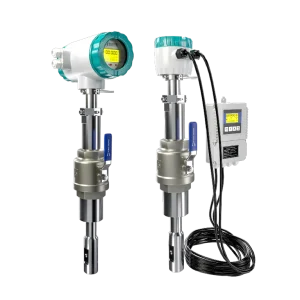
Unlike full-bore meters that measure the entire flow stream, an insertion magmeter utilizes a localized magnetic field at the tip of a probe.
The Physics:
Based on Faraday’s Law of Induction, the sensor generates a magnetic field. As conductive fluid flows through this field, it induces a voltage E proportional to the velocity v :
E = k · B · D · v
The electronics then calculate the total volumetric flow rate based on the pipe’s cross-sectional area and the velocity profile at the insertion point.
2. Why 2026 is the “Year of Insertion”
Industrial infrastructure is aging, and the cost of halting production for meter installation is no longer acceptable.
A. The “Hot-Tap” Advantage
You can install an insertion meter through a standard ball valve while the pipe is under full pressure. No cutting, no draining, no downtime.
B. Decoupling Cost from Pipe Size
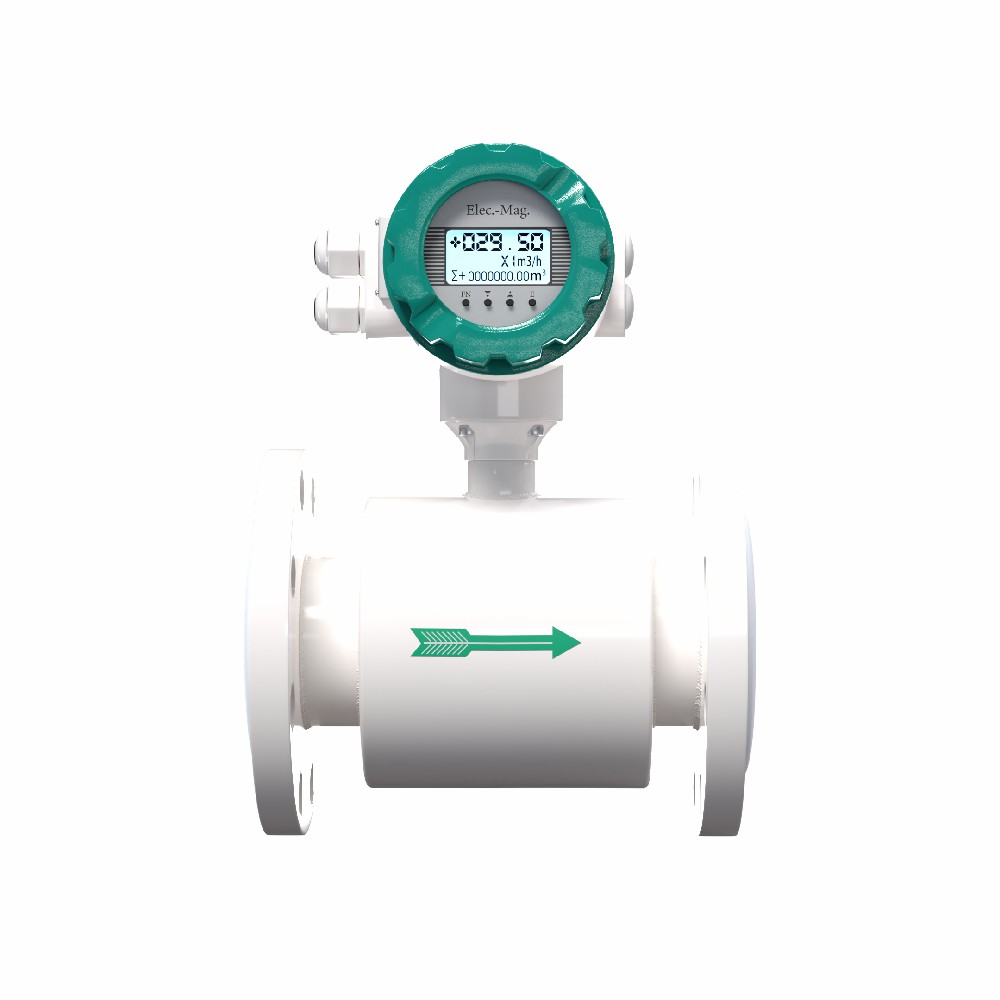
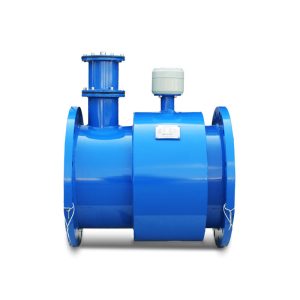
- Full-Bore Magmeter: Cost increases exponentially with pipe diameter (Materials + Logistics).
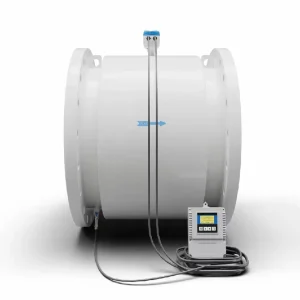
- Insertion Magmeter: The cost remains nearly constant whether the pipe is 200mm or 2000mm.
C. Smart Industry & IIoT Maturity
Modern sensors are now equipped with Digital Signal Processing (DSP) that filters out the hydraulic noise common in large-diameter systems, bringing accuracy to a level ($\pm 1.0\%$) that challenges traditional inline systems for utility management.
3. Comparison Matrix: Insertion vs. The Competition
| Feature | Insertion Magmeter | Full-Bore Magmeter | Clamp-on Ultrasonic |
| Ideal Pipe Size | 200mm to 3000mm | 15mm to 600mm | 50mm to 5000mm |
| Installation Cost | Low (Hot-tap possible) | High (Requires cutting) | Lowest (Non-invasive) |
| Maintenance | Low (Retractable) | Minimal | Low |
| Accuracy | ±1.0% to 2.0% | ±0.25% to 0.5% | ±1.0% to 3.0% |
| Pressure Drop | Negligible | Zero | Zero |
4. Engineering Best Practices: Maximizing Reliability
To achieve 2026-standard precision, field engineers must respect these critical constraints:
- Conductivity Threshold: The fluid must have a minimum conductivity of 5 µS/cm.
- Insertion Depth: The sensor must be positioned at the 1/8th diameter or the center, depending on the manufacturer’s velocity profile calibration.
- Straight Run Logic: Always prioritize a 10D upstream and 5D downstream configuration to ensure a laminar flow profile.
FAQ: Insertion Electromagnetic Flow Meters
No. Electromagnetic technology requires the fluid to have a minimum conductivity (typically ≥ 5 μS/cm). For hydrocarbons or deionized water, you should consider Ultrasonic or Vortex technologies.
Generally, no. A full-bore meter measures the entire flow area, typically achieving ±0.5% accuracy. An insertion meter measures a point velocity and extrapolates, typically achieving ±1.0%. However, for large-scale water distribution and cooling systems, this difference is often negligible compared to the massive cost savings
Hot-tapping is the process of installing a mounting nipple and ball valve onto a pressurized pipe, drilling through the valve into the pipe, and then inserting the flow sensor—all without stopping the fluid flow. This is a primary reason for the technology’s popularity in 2026.
Like all magmeters, entrained air or a partially full pipe will cause the meter to over-read or trigger an “Empty Pipe” alarm. The sensor electrodes must be fully submerged in the liquid at all times.
Most 2026 models support HART, Modbus RS485, and Profibus. Many newer “Smart” models also include Bluetooth for local configuration via mobile app and NB-IoT for direct cloud connectivity in remote water networks.
Expert Sourcing Note: As a leading manufacturer of high-performance instrumentation, KFBEST offers a range of insertion electromagnetic flow meters designed for the rigors of modern industrial and municipal applications. Our sensors feature advanced DSP for noise rejection and are available with full 1v1 engineering support to ensure your insertion depth and straight-run configurations are optimized for maximum ROI.
admin
System Administrator
Thank you for reading our technical insights and industry news.